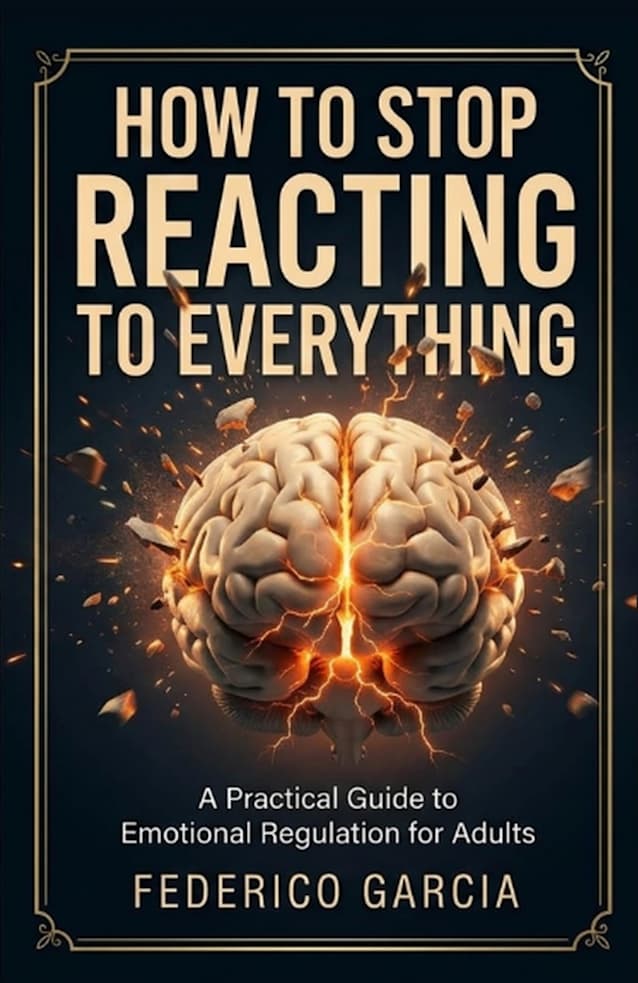
How To Stop Reacting to Everything. A Practical Guide to Emotional Regulation for adults:
About
What if the problem isn’t that you feel the reaction—but what happens next?
You get a text and immediately assume the worst. Someone cuts you off in traffic and your heart starts pounding. Your boss dismisses your idea, you say nothing, and then you come home angry at the people you love. Your kid pushes one more button after a long day and your response is far bigger than the moment. Or maybe you don’t explode at all—you shut down, freeze, replay the conversation, or carry resentment long after everyone else has moved on.
How to Stop Reacting to Everything is a research-based guide to emotional regulation for adults who want to manage triggers, control anger, build self-control, strengthen resilience, and develop real emotional intelligence.
The author writes from lived experience. His history with anger, grief, addiction, therapy, recovery, relationships, fatherhood, and rebuilding his life gives this book a different starting point: you are not broken because you have strong reactions. You can learn what happens between the trigger and the behavior—and create space in that gap.
Inside this book, you’ll learn how to:
• Understand your triggers and recognize what happens in your brain and body when your alarm goes off.
• Regulate anger and emotional reactions before frustration becomes an argument, outburst, damaging message, or decision you regret.
• Recognize hidden reactions including freezing, shutting down, emotional suppression, grief, resentment, and silent buildup.
• Stop rumination and overthinking when your mind keeps replaying an argument, insult, mistake, or conversation.
• Handle everyday triggers involving driving, waiting in lines, strangers, social media, notifications, and online outrage.
• Deal with workplace and financial stress when pressure, low control, and money worries affect attention, decisions, and self-control.
• Respond differently in relationships when love, defensiveness, disappointment, and resentment collide.
• Set boundaries by learning how to make direct requests, say no, and communicate what you need.
• Calm your body before you respond with breathing techniques, the physiological sigh, deliberate pauses, and practical tools.
• Reframe thoughts that fuel anger using cognitive behavioral therapy principles such as mind-reading, personalization, all-or-nothing thinking, and labeling.
• Handle parenting and caregiver stress when exhaustion and responsibility push you toward your breaking point.
• Repair relationships after you’ve caused damage with accountability, meaningful apologies, and concrete action.
• Let go of anger you’re still carrying through a practical approach to forgiveness that does not require reconciliation or pretending the hurt never happened.
• Know when self-help isn’t enough and recognize when professional support is necessary.
The book progresses from reactions involving strangers to people who have power over you, people who are your equals, and finally people who have less power to push back. Each chapter combines science, plain-language explanation, real-life scenarios, and a practical tool you can use.
The goal is to recognize the alarm, slow down the automatic response, question the story your mind is telling you, and choose what happens next.
You’ll also find quick-reference cards with practical tools for difficult moments.
You can’t always control what happens. But you can learn to control what happens next.
If you struggle with anger, emotional reactions, impulsive behavior, overthinking, rumination, difficult relationships, workplace stress, parenting frustration, caregiver stress, resentment, boundaries, or self-control, this book was written for you.
You don’t need to become a different person. You need to become the person who gets to choose the response.